Posts

Showing posts with the label eclipse

Annular Solar Eclipse of 26 December 2019 (Simulated)

Image
🌞Eclipses 🌚  are heavenly visual feasts of celestial bodies hide and seek game with light and shadow. Indeed, they are rare events ! We need to be in the right place 🗺 and at right time  ⌚ to watch an eclipse unfurl. 💥How about watching a future eclipse now ? Yes, it is possible !   Curious to know ? 🤔 We can simulate it in our PC 💻 and enjoy. No need to travel far off. It would be truly interesting to watch it in advance and later wait at the right place to witness it. ❓ How to simulate a heavenly event ? Use the free open source Astronomy software  "Stellarium"  - to enjoy the realistic sky.⭐🌟⋆ It can be downloaded at  https://stellarium.org/ Set the location (latitude, longitude), change the time, play and watch !!! This would be really interesting and rewarding activity.  Now, let us see how an  Annular Solar Eclipse of  26 December 2019  ðŸ“… look like. An Annular Solar Eclipse...
Solar Eclipse over Tirupati 09 Mar 2016 (simulated)

Image
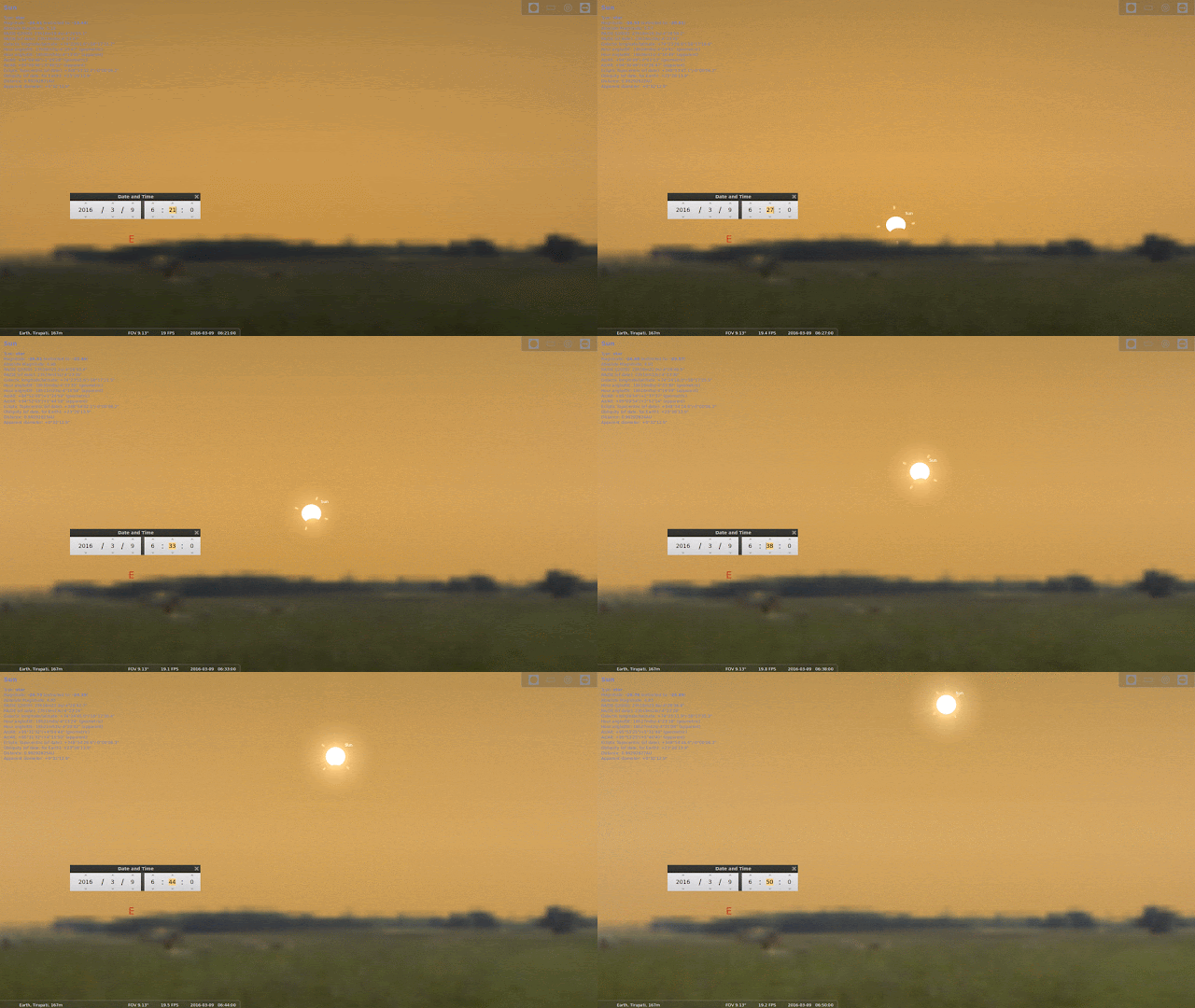
Solar Eclipse (09 Mar 2016) is hardly visible over Tirupati. Here is an animated version (Figure (a)) of the simulation I have prepared using the free open source "Stellarium" software. The Sun rises over Tirupati by 06:23 IST. Meanwhile eclipse has already begun and being in penumbra region, it's partial eclipse over here. Click here to see the eclipse For reference, the figure (b) of eclipse locations are shown in the figure below (scroll down) which also shows time in Tirupati during the events.  (courtesy: timeanddate.com ) Figure (a): Animation of the solar eclipse (simulated) over Tirupati. 'E' indicates East Figure (b): How eclipse happens world wide (courtesy: timeanddate.com)

Equinox & Solstice - a better view

Image
Equinox & Solstice (view from Space).  Doesn't it convey better information than the usual cartoons.....?  I have taken the Satellite images from Meteosat via. Dundee satellite Receiving Station and made the matrix using GIMP.

Don't miss to watch the 'Transit of Venus'

Image
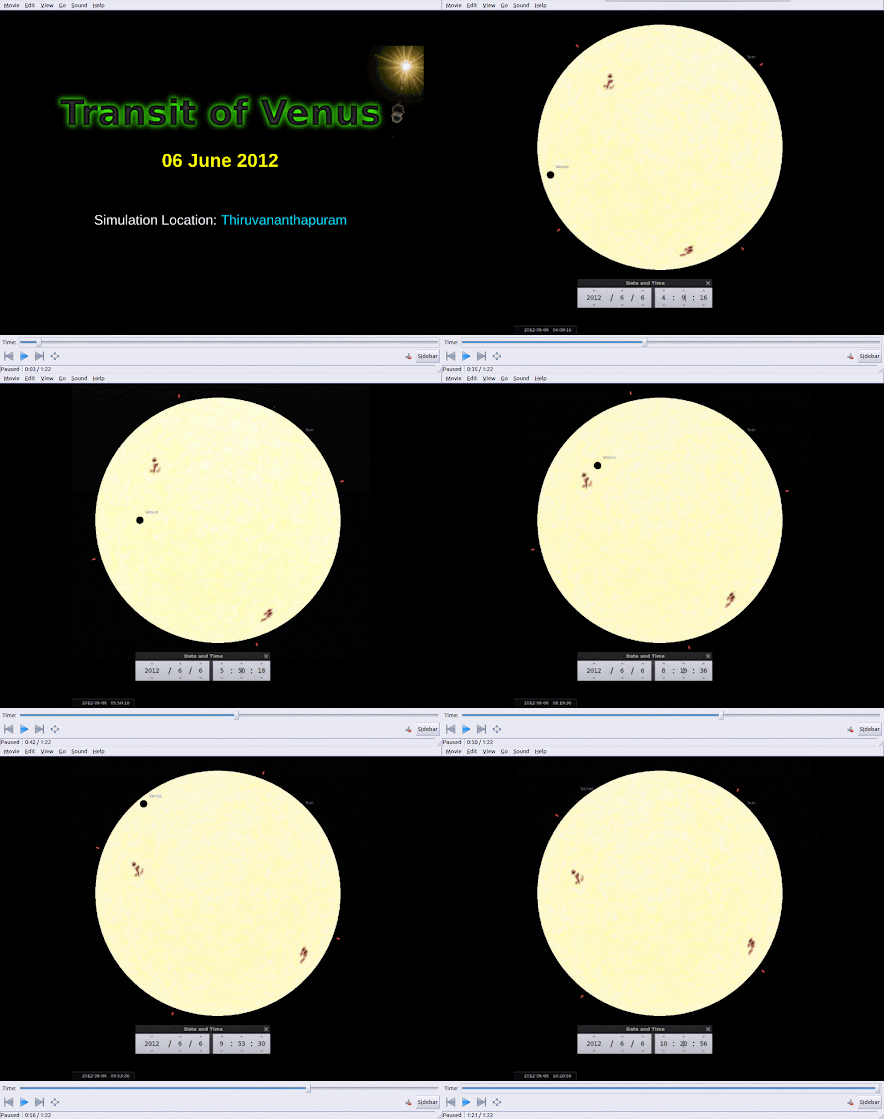
Be prepared to watch a heavenly drama on 6 June 2012. The Venus can be seen as a black dot travelling across the Solar Disk. Here is my Simulation: Yes, it is the "Transit of Venus across the Sun" Path-- L to R Credit: Michael Zeiler, eclipse-maps.com India comes under the visibility of the event after Sunrise. See the graphic below: Thiruvananthapuram can view it right from sunrise to 10:22 AM. The graphic was prepared using the tool provided in  http://transitofvenus.nl/wp/where-when/local-transit-times/   You can change the location and see about your visibility to the drama. Also read the following blog for wonderful information and graphics. http://blogs.esa.int/venustransit/        (nice and informative blog by ESA) http://eclipse-maps.com/Eclipse-Maps/Transits.html     (Transit maps) http://sunearthday.nasa.gov/transitofvenus/ You can also find how to watch the event.... Follow safe way.... take care ...

Nasa to release TMA in 5 sounding rockets to study Jet Stream

Image
Nasa is gearing up to have 5 consecutive launches of sounding rockets which would releasr Tri-Methyl-Aluminum higher in the sky which would be acting like tracers in the Jet Stream. It would be tracked by the ground based cameras. A similar experiment was done by ISRO in Jan 2010 during the annular solar eclipse.   Read more: http://www.nasa.gov/mission_pages/sunearth/missions/atrex-nightlight.html

Our Recent Paper in JASTP

Image
Journal of Atmospheric and Solar-Terrestrial Physics Volume 74 , January 2012, Pages 232–237 Impact of a noon-time annular solar eclipse on the mixing layer height and vertical distribution of aerosols in the atmospheric boundary layer Manoj Kumar Mishra,  K. Rajeev ,  ,  Anish Kumar M. Nair,  K. Krishna Moorthy,  K. Parameswaran For full paper, click this link:  http://dx.doi.org/10.1016/j.jastp.2011.10.012 , Abstract Impact of the long duration noontime annular solar eclipse on 15 January 2010 on the vertical distribution of aerosols and mixing layer height ( H M ) in a well-developed convective atmospheric boundary layer (ABL) has been investigated using continuous Lidar observations over a tropical coastal station, Thumba (8.5°N, 76.9°E). This study shows that  H M  has decreased from its peak value of ∼1800 m at 12:00 h to ∼1000 m following the annular phase of the eclipse (13:17 h), whil...

Lunar Eclipse (Real fotos & Simulation)

Image
My colleague Mr.Sobhan Kumar Kompalli, Scientist in Space Physics Laboratory has clicked more than 100 snaps of the beautiful 'Lunar Eclipse' that entertained earthlings on 10-Dec-2011. Here is a matrix of few selected snaps by the  amateur  photographer. Also have a view of the Simulated Lunar Eclipse ( animation)  which I generated using the open source software 'Stellarium'. You are welcome to watch  the drama unfold......! Photograph by Mr.Sobhan Kumar Kompalli (sobhan1urs@gmail.com)

Can Moon's shadow make Waves in the Atmosphere....?

Image
    As the Moon blots out the Sun during a solar eclipse, the patch of the Earth that is cast into darkness cools. Meanwhile, the surrounding regions continue to receive the full brunt of the Sun's energy.     This temperature difference causes waves in the atmosphere to build up behind the leading edge of the moon's shadow, like the bow wave of a ship.    Although scientists have hypothesized about the moon's atmospheric wake since the 1970's, it wasn't until a July 22, 2009 eclipse in Japan and Taiwan that they observed the phenomenon directly. Read details: http://news.discovery.com/earth/moon-makes-waves-during-eclipse-111007.html#mkcpgn=rssnws1 The research was published in Geophysical Research Letters. J. Y. Liu of the National Central University of Taiwan led the research.